
CNLawBlog is an independent digital publication that aims to make complex subjects easier to understand through structured, accessible, and practical articles. Its current website describes coverage extending beyond law into technology, business, finance, education, health, real estate, lifestyle, and other practical topics. The publication says it was founded in August 2018 and focuses on providing useful information to a broad online audience.
Understanding What CNLawBlog Is
CNLawBlog can be viewed as an online knowledge and publishing platform designed to organize information into readable, accessible articles. The name naturally suggests a strong connection with legal content, and law remains an important part of the website’s identity. However, the current publication covers a much wider range of subjects, including technology, business, finance, education, health, home improvement, real estate, lifestyle, and gaming.
The central idea behind a platform such as CNLawBlog is accessibility. Legal and professional subjects can often contain terminology that ordinary readers find difficult to understand. A well-structured digital article can introduce the topic, explain important terminology, provide examples, and help readers identify the issues they may need to investigate further.
This approach is particularly useful in the modern internet environment, where people frequently search for answers before contacting a professional. Instead of presenting information as an academic textbook, a practical blog can organize it around real questions and everyday situations.
At the same time, readers should distinguish educational content from professional advice. A blog article can help someone understand a legal or financial concept, but it should not automatically be treated as a substitute for a qualified professional or an official government source.
| Feature | General Description |
|---|---|
| Platform type | Independent digital publication |
| Main strength | Accessible informational content |
| Major category | Law |
| Other subjects | Technology, business, finance, education, health, lifestyle |
| Target readers | General online audience |
| Content style | Structured and explanatory |
The Evolution of CNLawBlog as a Digital Publication
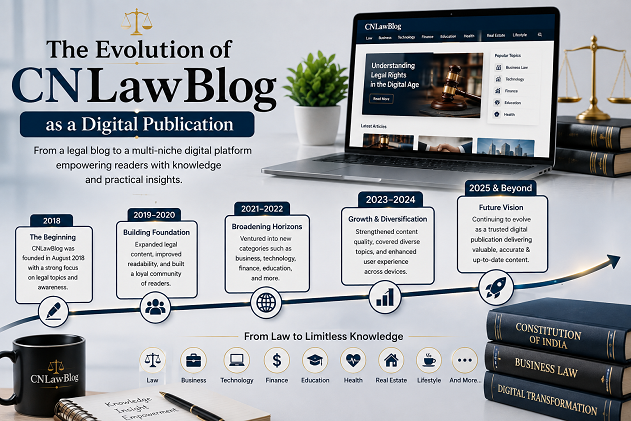
According to its own About page, CNLawBlog was founded in August 2018 with a focus on making useful information more accessible. The publication says that it began with a strong foundation in legal publishing and subsequently expanded into numerous other areas.
This evolution reflects a broader change in digital publishing. Many websites initially develop around a particular subject before expanding as readers begin searching for related information. A legal website, for example, may naturally encounter questions involving business, finance, technology, employment, privacy, property, or education.
The expansion can create an advantage because real-world issues rarely fit into a single category. A business owner might need information about contracts, taxation, cybersecurity, employment, and digital marketing at the same time. Similarly, an individual researching personal legal rights may also need practical information about finances, insurance, property, or employment.
CNLawBlog’s current positioning therefore appears broader than the name alone suggests. Its homepage describes it as an independent online publication covering law, technology, business, finance, health, education, and other subjects.
This wider editorial direction can make a platform more useful for readers who prefer discovering related subjects in one place. However, it also means that readers should evaluate individual articles according to their subject, author, sources, date, and level of expertise rather than assuming that every article represents specialist legal advice.
Read More: Techslassh.com – Future of Technology 2026
Why Legal Content Needs Simple and Clear Language
Law is one of the areas where communication quality matters enormously. Legal documents frequently contain specialized terminology, complex conditions, exceptions, deadlines, and jurisdiction-specific rules. For someone without legal training, reading a statute or court document can therefore be challenging.
A legal-focused blog can serve an important educational role by translating complicated concepts into ordinary language. Instead of simply presenting technical definitions, an effective article can explain what a concept means, why it matters, where it applies, and what questions a reader should ask next.
CNLawBlog’s stated mission emphasizes making complex subjects clear, practical, and understandable for readers with different levels of knowledge. This reader-first approach is particularly valuable for people conducting preliminary research.
For example, someone unfamiliar with corporate law might not understand the difference between a contract dispute, regulatory obligation, and corporate governance issue. A structured article can introduce those concepts separately and demonstrate how they relate to one another.
However, simplicity should not come at the expense of accuracy. Legal rules can vary by country, state, province, court, industry, and individual circumstances. Therefore, simplified explanations should be treated as educational starting points rather than universal answers.
| Legal Content Quality | Why It Matters |
|---|---|
| Clear terminology | Helps non-specialists understand concepts |
| Accurate information | Reduces misunderstanding |
| Current references | Laws and regulations can change |
| Jurisdiction awareness | Rules differ between locations |
| Practical examples | Connects theory to real situations |
| Professional review | Useful for high-stakes legal issues |
Major Topics Readers Can Explore
One of the distinctive aspects of the current CNLawBlog platform is its broad subject coverage. Its own description lists law, technology, business, finance, education, health, home improvement, real estate, lifestyle, gaming, and other practical areas.
This diversity gives the publication a magazine-like quality rather than restricting it to a single narrow legal niche. Readers can move from an article about a legal concept to content about technology or business without leaving the same publication.
The law category can be especially valuable for introductory research because legal subjects often overlap with other disciplines. Employment law intersects with business management. Data privacy connects law with technology. Real estate combines property law, finance, contracts, and taxation. Intellectual property involves both legal rights and technological innovation.
Technology is another increasingly important subject because digital transformation creates new legal questions. Privacy, cybersecurity, artificial intelligence, online transactions, digital intellectual property, and platform regulation all demonstrate how closely technology and law are connected.
Finance and business content similarly broaden the practical usefulness of the platform. Readers may encounter subjects related to financial decisions, companies, entrepreneurship, investment concepts, or business operations.
The key advantage of broad coverage is convenience, but the key responsibility for readers is verification. The more specialized or consequential the topic becomes, the more important it is to consult authoritative primary sources.
CNLawBlog and the Importance of Research-Based Content
A strong information website should do more than fill pages with words. Good content requires research, organization, context, and editorial judgment. CNLawBlog states that its objective is to provide well-researched and accessible information.
Research-based writing is particularly important for legal and financial topics because inaccurate information can lead to poor decisions. A responsible article should distinguish established facts from interpretation, explain limitations, and avoid presenting uncertain information as guaranteed.
The publication’s stated editorial philosophy emphasizes answering genuine questions and creating meaningful reader value rather than focusing only on search-engine rankings. That philosophy is consistent with the broader movement toward people-first digital content.
Readers can also participate in the research process. When reading an article, they can ask several useful questions: Who wrote it? When was it published or updated? Are important claims supported by reliable sources? Does the article identify the jurisdiction? Are official documents or primary sources available?
These questions become especially important when an article discusses laws that may change over time.
A useful research process can be represented as follows:
Search → Read → Compare → Verify → Understand → Apply Carefully
The most important step is verification. A blog can introduce an issue efficiently, but official legislation, court decisions, regulatory agencies, academic research, or qualified professionals may provide the final authority needed for important decisions.
Read More: Infoohub org Review 2026
The Role of CNLawBlog in Modern Digital Learning
The internet has transformed how people learn. Instead of relying exclusively on printed books, classrooms, or professional consultations, individuals can now research a topic within minutes. Digital publications such as CNLawBlog participate in this wider information ecosystem by presenting subjects in an accessible format.
This is especially helpful for beginners. A student studying business law, an entrepreneur researching regulations, or an ordinary reader encountering an unfamiliar legal term may first need a basic explanation before consulting advanced resources.
Structured online articles can provide that first layer of knowledge. Headings allow readers to scan information quickly, tables can summarize differences, examples can clarify abstract ideas, and FAQs can address common concerns.
The educational value also comes from connecting different subjects. A reader researching intellectual property might discover how trademarks, patents, copyright, branding, and technology interact. Someone researching business operations might discover the importance of contracts, employment rules, privacy requirements, and financial planning.
However, online learning requires critical thinking. Search engines can produce large quantities of information, but popularity does not automatically equal accuracy. Readers should compare information and prioritize authoritative sources when the consequences of being wrong are significant.
Therefore, CNLawBlog can be understood as part of the first stage of digital learning: helping readers understand a topic well enough to know what they need to investigate next.
CNLawBlog’s Value for Businesses and Entrepreneurs

Businesses increasingly operate across several professional areas simultaneously. An entrepreneur may need to understand contracts, employment responsibilities, intellectual property, privacy, technology, finance, and regulatory compliance.
A broad informational platform can therefore be useful during the early research stage. Business owners can use explanatory articles to familiarize themselves with terminology before speaking with lawyers, accountants, consultants, or other professionals.
For example, a new entrepreneur may not initially know what questions to ask about intellectual property protection. After reading introductory material, the entrepreneur may understand the difference between trademarks, copyright, patents, and trade secrets. This knowledge can make a later professional consultation more productive.
Similarly, technology companies may encounter questions involving data privacy and cybersecurity. A basic article can explain concepts such as personal information, data processing, security obligations, and compliance planning.
The important distinction is between information and implementation. Reading about a legal obligation does not necessarily establish that a business is compliant. Actual compliance may require reviewing contracts, organizational procedures, licenses, records, technical systems, and applicable laws.
| Business Need | Useful Preliminary Research |
|---|---|
| Starting a company | Corporate and business concepts |
| Protecting a brand | Trademark and IP basics |
| Hiring employees | Employment-law concepts |
| Managing data | Privacy and cybersecurity |
| Signing contracts | Contract fundamentals |
| Expanding internationally | Cross-border legal considerations |
| Managing finances | General financial information |
CNLawBlog can therefore function as a starting point for business education while professional advice remains important for complex decisions.
Read More: Techsslaash.com – Pushing Limits with Powerful Features for Tech Writers 2026
How Readers Should Evaluate CNLawBlog Content
Not every article on the internet should be accepted without question, and legal content deserves particularly careful evaluation. CNLawBlog describes itself as an independent publication rather than a government institution or law firm.
That distinction is important because the authority of a source depends on its purpose and evidence. A blog may provide an excellent explanation without being the final legal authority.
Readers should evaluate individual articles using several criteria. First, check the publication date and whether the article has been updated. Second, examine the author’s identity and expertise when available. Third, look for supporting evidence. Fourth, determine whether the article clearly identifies the relevant country or jurisdiction. Finally, compare important claims against primary authorities.
This process is particularly important when the topic involves legal deadlines, financial transactions, regulatory compliance, immigration, taxation, employment disputes, criminal matters, or other high-stakes issues.
A simple credibility checklist can help:
| Question | What to Check |
|---|---|
| Who wrote it? | Author and relevant expertise |
| When was it published? | Publication/update date |
| Where does it apply? | Country or jurisdiction |
| What supports the claims? | Sources and references |
| Is the topic current? | Recent laws and regulations |
| Is advice required? | Consult a qualified professional |
The goal is not to distrust online content. Instead, the goal is to use it intelligently—as an educational resource within a larger research process.
CNLawBlog and the Future of Accessible Legal Publishing
The future of legal publishing is likely to become increasingly digital, interactive, and user-focused. Readers expect information to be available quickly, written clearly, and organized around practical questions. Traditional legal writing will continue to be important, but explanatory digital content can bridge the gap between technical law and everyday understanding.
CNLawBlog’s stated emphasis on accessibility reflects this broader trend. Its mission is to make information easier to understand for people from different backgrounds and levels of knowledge.
Future legal publishing may increasingly incorporate interactive tools, searchable databases, visual explanations, timelines, document checklists, and frequently updated guides. Artificial intelligence may also assist with information discovery and content organization, although human oversight and authoritative verification remain essential for legal matters.
Another important development will be transparency. Readers are becoming more interested in knowing who created an article, what sources were used, when information was checked, and whether commercial relationships exist.
For platforms covering multiple subjects, maintaining clear editorial standards will become even more important. A website discussing law, technology, finance, and health must ensure that readers understand the difference between general educational content and specialist advice.
The strongest digital legal publications will likely combine clarity, accuracy, transparency, usability, and responsible updating. Those qualities can help readers navigate increasingly complicated information environments.
Read More: How2Invest com mx Review
Final Assessment: Why CNLawBlog Can Be Useful
CNLawBlog represents an interesting model of modern digital publishing because its identity extends beyond the traditional concept of a narrowly focused law blog. Its own website describes it as an independent publication covering law alongside technology, business, finance, education, health, real estate, lifestyle, and other practical subjects.
Its greatest potential value lies in accessibility. Complex topics become easier to approach when they are divided into logical sections and explained using straightforward language. For students, general readers, entrepreneurs, and people beginning research, this type of content can provide a useful foundation.
Nevertheless, readers should maintain a critical approach. A legal article should not automatically be considered professional legal advice simply because it appears online. Laws vary by jurisdiction and can change, while individual circumstances can significantly affect the correct legal interpretation.
The best way to use CNLawBlog is therefore as a research and learning starting point. Readers can use articles to understand terminology, identify important questions, discover relevant concepts, and prepare for deeper research. For important legal, financial, medical, or business decisions, authoritative sources and qualified professionals should be consulted.
Ultimately, the value of any digital publication depends on how responsibly its information is created and how intelligently its readers use it. CNLawBlog’s broad educational approach can make complex subjects more approachable, while careful verification allows readers to turn online information into genuinely useful knowledge.
Frequently Asked Questions (FAQ)
What is CNLawBlog?
CNLawBlog is an independent online publication that provides informational content across several subjects, including law, technology, business, finance, education, health, real estate, and lifestyle. It is designed to make complex topics easier for general readers to understand.
Is CNLawBlog only about legal topics?
No. Although its name has a strong legal association, the platform covers a variety of topics. Readers may find content related to technology, business, finance, education, health, home improvement, real estate, lifestyle, and other practical subjects.
Who can benefit from reading CNLawBlog?
Students, entrepreneurs, professionals, researchers, and general internet users can potentially benefit from its informational content. It can be particularly useful for readers who want a straightforward introduction to an unfamiliar topic.
Can CNLawBlog articles be considered professional legal advice?
Generally, online informational articles should not automatically be treated as personalized legal advice. Legal rules can depend on jurisdiction and individual circumstances. For an important legal matter, readers should consult a qualified legal professional.
Why is accessible legal content important?
Legal terminology can be difficult for people without formal legal training. Clear explanations can help readers understand basic concepts, identify relevant questions, and conduct more informed research before seeking professional assistance.
Does CNLawBlog cover technology and business?
Yes. The website describes coverage extending beyond law into areas such as technology, business, finance, education, health, real estate, and lifestyle. This broad approach allows readers to explore subjects that often overlap with legal and professional issues.
How should readers evaluate information published on CNLawBlog?
Readers should consider the article’s publication or update date, author information, supporting sources, jurisdiction, and relevance to their particular situation. Important claims should be compared with authoritative or primary sources.
Is CNLawBlog useful for students?
Yes. Students can use explanatory articles as introductory learning resources, particularly when they need to understand unfamiliar terminology or concepts. However, academic assignments should rely on appropriate scholarly and authoritative sources when required.
Can business owners use CNLawBlog for research?
Business owners can use the platform for preliminary research into subjects such as business, finance, technology, contracts, and legal concepts. For decisions involving compliance or significant financial consequences, professional advice may still be necessary.
What makes CNLawBlog different from a traditional law website?
Its broader subject coverage is one distinguishing characteristic. Rather than concentrating exclusively on legal matters, CNLawBlog presents information across multiple categories, giving it a wider digital-publication or magazine-style orientation.
Should readers verify information from CNLawBlog?
Yes. Verification is especially important for legal, financial, medical, and regulatory topics because rules and information can change. Readers should check current authoritative sources before making consequential decisions.
What is the best way to use CNLawBlog?
The best approach is to use CNLawBlog as an educational and preliminary research resource. Start with an article to understand the subject, identify important questions, compare the information with authoritative sources, and seek professional guidance when the situation requires it.
Conclusion
CNLawBlog is best understood as an independent digital information platform with a strong legal identity but a much broader range of modern topics. Its emphasis on structured, accessible explanations makes it potentially useful for readers who want to understand complicated subjects before exploring authoritative resources. The platform’s stated mission is centered on making quality information accessible and understandable.
For casual learning and preliminary research, such content can save time and provide valuable context. For decisions involving significant legal, financial, health, or business consequences, however, readers should verify information through official sources and seek appropriate professional advice. Used in that balanced way, CNLawBlog can serve as a practical part of a modern research and learning routine.
