
Why “Best” Depends on the Trader
No single trading app is best for everyone. A college student buying a few fractional shares has almost nothing in common with a day trader scalping futures or a retiree building a dividend portfolio. Each needs different tools, costs, and protections.
The better question is which app is best for you. Before comparing logos and ratings, define your profile. How often will you trade? Which markets do you care about? How much money are you starting with? Do you want guidance, or do you prefer to research on your own?
| Trader Type | Main Need | What Matters Most |
|---|---|---|
| Absolute beginner | Simplicity | Clean interface, learning material |
| Long-term investor | Low cost, stability | Low fees, retirement accounts, dividends |
| Active day trader | Speed and data | Fast execution, advanced charts |
| Crypto enthusiast | Asset variety | Security, coin selection, withdrawal options |
| Global diversifier | Market access | International stocks, multi-currency support |
Writing down your answers first turns a confusing marketplace into a short list of two or three realistic candidates. Most disappointment with best trading app comes from choosing a platform built for someone else’s habits.
Regulation and Safety: The Non-Negotiable Foundation
Before looking at features, confirm that the app is legitimate. A beautiful interface means nothing if the company is unregulated or your money isn’t protected. In most countries, a reputable broker is licensed by a financial authority, such as the SEC and FINRA in the United States, the FCA in the United Kingdom, or SEBI in India.
Check three things:
- Licensing: Search the regulator’s public database for the company’s name. Don’t rely on the app’s own claims.
- Client money protection: Many jurisdictions have investor-protection schemes that cover your holdings if the broker fails. They don’t cover market losses.
- Segregated accounts: Your funds should be held separately from the company’s operating money.
Be wary of apps that promise guaranteed returns, pressure you to deposit quickly, or can’t show where they are registered. These are classic warning signs of fraud. A slightly less polished app that is properly regulated is a far better choice than a flashy one with no oversight. Safety isn’t a feature to compare; it’s the entry requirement.
Read More: Trading Tick Call vs Put: A Complete Guide for Modern Traders
The True Cost of Trading
“Commission-free” is one of the most common marketing phrases in the industry, but it rarely means free. Brokers earn money in several ways, and understanding them can save you a surprising amount over the years.
| Cost Type | What It Is | Where It Hides |
|---|---|---|
| Commission | Fee per trade | Often zero for stocks, not for options or international trades. |
| Spread | Gap between buy and sell price | Larger in forex, crypto, and CFDs |
| Currency conversion | Fee for converting money | Costly on international purchases |
| Account fees | Inactivity, maintenance, withdrawal | Fine print |
| Payment for order flow | Broker is paid to route your orders | May affect price quality slightly |
A trader who makes ten trades a year cares most about account and conversion fees. A frequent trader should focus on spreads and execution quality. Read the full fee schedule, usually found on the broker’s website under “pricing” or “legal documents,” and run a simple calculation based on your own expected activity. Over a decade, a small percentage difference compounds into real money.
Interface and User Experience
A best trading app is something you may open dozens of times a week, often under time pressure. Design matters more than people admit, because confusing screens lead to expensive mistakes such as buying the wrong quantity or choosing a market order instead of a limit order.
A well-designed app offers:
- Clear order screens that show cost, quantity, and order type before confirmation
- Easy navigation between portfolio, watchlist, and search
- Customizable alerts for price movements and news
- Dark mode and readable fonts for long sessions
- Quick access to your holdings, with profit and loss shown in plain language
Beginners tend to prefer minimalist layouts, while experienced traders often want dense dashboards with many indicators on one screen. A helpful test is to open a demo or small account and try placing a pretend order without reading any instructions. If you can complete it confidently in under a minute, the design suits you. If you hesitate or feel lost, that friction will cost you later. Check whether the app also has a web or desktop version that stays in sync, since many people prefer larger screens for serious analysis.
Charting and Analysis Tools
Good decisions depend on good information. For many traders, charting quality is the deciding factor between two otherwise similar apps. Some brokers offer basic line charts, while others integrate professional-grade analytics, and some partner with dedicated charting platforms.
Useful tools include:
- Candlestick, bar, and line chart styles
- Dozens of technical indicators, such as moving averages, RSI, and MACD
- Drawing tools for trend lines and support and resistance levels
- Multiple timeframes, from one minute to monthly
- Stock screeners that filter by sector, valuation, or momentum
- Access to financial statements, analyst data, and earnings calendars
Long-term investors may not need advanced charting. They are better served by fundamental data like earnings history, dividend records, and company summaries. Active traders, in contrast, should look for real-time data, since delayed quotes can make short-term strategies unworkable. Ask whether real-time data is free or requires a paid subscription. One practical tip is to use a standalone charting service alongside a simple broker app, which many experienced traders do. Matching your analytical style to the app avoids both paying for tools you never use and lacking tools you urgently need.
Read More: What Is Algo Trading 2026: A Complete Guide to Algorithmic Trading
Range of Markets and Instruments
Different apps open different doors. Some focus only on local stocks, while others provide access to global exchanges, options, futures, bonds, forex, mutual funds, ETFs, and cryptocurrencies. More choice isn’t automatically better, since each instrument carries its own risks.
| Instrument | Typical Risk Level | Suits |
|---|---|---|
| Index funds / ETFs | Lower to moderate | Beginners, long-term investors |
| Individual stocks | Moderate to high | Investors who research companies |
| Bonds | Lower | Income-focused investors |
| Options and futures | High | Experienced, disciplined traders |
| Forex and CFDs | High, often leveraged | Advanced traders only |
| Cryptocurrency | Very high | Those who accept extreme volatility |
Think about where you want to be in three years, not just today. If you may eventually want international exposure or retirement accounts, choosing a platform that can grow with you saves the hassle of transferring assets later. Also check whether fractional shares are supported, because they let small investors own pieces of expensive stocks. Remember that regulations decide which products are available in your country, so an app popular overseas may not offer everything locally.
Education and Beginner Support
New traders lose money mostly because they don’t understand what they are doing, not because they chose the wrong app. The best platforms for beginners invest in education, treating customers as learners rather than just transaction sources.
Look for:
- Built-in tutorials and glossaries explaining terms like “stop-loss” and “diversification”
- Paper trading (demo accounts) that let you practice with virtual money
- Webinars and market commentary from the broker’s own analysts
- Responsive customer support by chat, email, or phone
- Clear help-center articles that answer common questions
Paper trading is especially valuable. Spend a few weeks practicing, make deliberate mistakes, and learn how order types behave, all without risking real savings. Support quality is also easy to overlook until something goes wrong, such as a failed deposit or a locked account. Before funding an account, send the support team a simple question and see how quickly and clearly they respond. Remember that educational content from a broker can sometimes encourage more best trading app, so balance it with independent sources such as books and non-commercial financial education sites.
Speed, Execution, and Reliability
For a long-term investor, a one-second delay is irrelevant. For an active trader, it can change the profit on a trade. Execution quality describes how quickly and at what price your order is filled, and it varies between brokers.
Key reliability points include:
- Uptime during volatility: Some apps have crashed during major market events, exactly when users needed them most
- Order fill speed: How quickly a market order is completed
- Slippage: The difference between expected price and actual execution price
- Server stability and quick loading of live prices
- Backup options, such as phone support for placing trades if the app fails
Search recent user reviews and financial news for reports of outages or complaints about frozen screens on busy trading days. App store ratings can be helpful, but read the detailed reviews rather than the star average, since some complaints concern customer service rather than technical performance. It also helps to understand order types: limit orders protect you from poor prices, while market orders prioritize speed. A reliable app combined with sensible order habits protects you better than raw speed alone.
Comparing Popular Types of Trading Apps
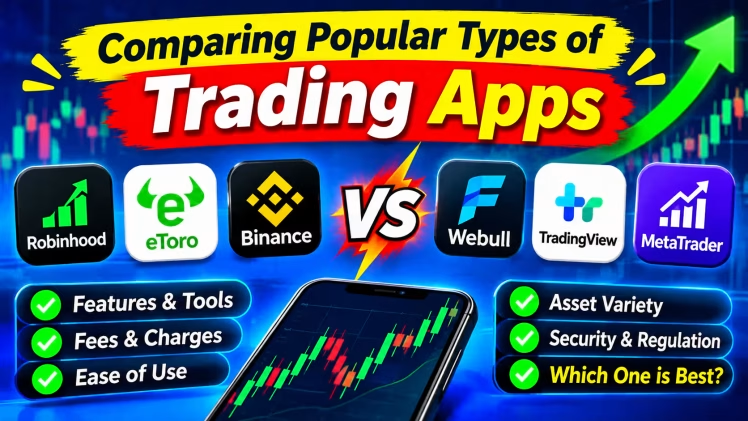
Rather than ranking individual brands, which changes constantly, it is more useful to understand the main categories of platforms and what each does best. Real examples of each type exist in most markets, and you can match them to your needs.
| Category | Strengths | Limitations |
|---|---|---|
| Beginner-friendly mobile brokers | Simple design, low barriers, fractional shares | Limited research and advanced tools |
| Full-service traditional brokers | Research, retirement accounts, wide product range | Interfaces can feel heavy |
| Professional/advanced platforms | Powerful analytics, global access, low margin costs | Steep learning curve |
| Social/copy-trading apps | Learn from other traders, community features | Copying doesn’t guarantee results, higher risk |
| Crypto exchanges | Wide coin selection, 24/7 trading | Security risks, volatile, varied regulation |
| Local-market apps | Tailored to domestic exchanges, local payment methods | Limited international access |
A sensible approach is to start with the category closest to your profile and test it with a small amount. Many people eventually use two apps: a simple one for long-term holdings and a more advanced one for active best trading app. Be cautious with social trading features, since a leader’s past performance doesn’t predict future results, and copying someone else’s risk level may not match your own comfort.
Security and Risk Management on Your Phone
Your trading app holds money, personal documents, and banking details, which makes it a target for criminals. The best apps take security seriously, but you also play a role in protecting your account.
Essential protections include:
- Two-factor authentication (2FA): Prefer an authenticator app over SMS where possible
- Biometric login: Fingerprint or face unlock adds convenience and safety
- Strong, unique passwords stored in a reputable password manager
- Official app downloads only, since fake trading apps appear in unofficial stores
- Alerts for logins and withdrawals so you notice suspicious activity quickly
- Avoiding public Wi-Fi when making transactions
Beyond cybersecurity, practice financial risk management. Never trade money you can’t afford to lose, diversify rather than putting everything in one asset, and avoid emotional decisions during market swings. Be skeptical of messages on social media or chat groups promising quick profits, as these are common scams. Features like stop-loss orders and price alerts help enforce discipline. An app can offer tools, but your habits ultimately decide whether best trading app builds wealth or drains it.
Conclusion
The best trading app is the one that is regulated, affordable, easy to use, and well matched to your goals and experience. Start by identifying what you need, verify the company’s legitimacy, calculate the real costs, and test the platform with a small amount or a demo account. Keep learning, protect your accounts, and never invest money you can’t afford to lose. A careful choice today can prevent expensive mistakes tomorrow.
