
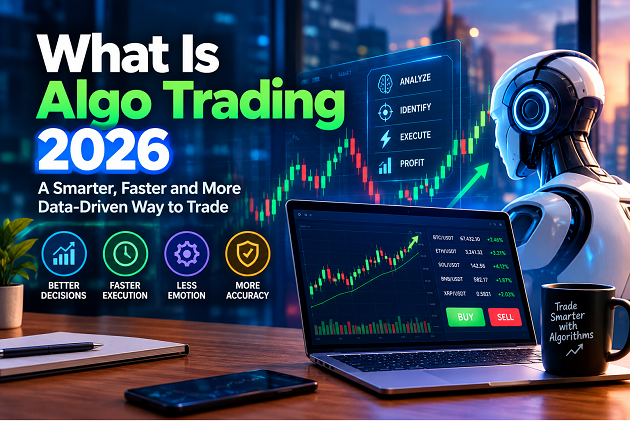
“Algo trading” is short for algorithmic trading. You set the rules, for example “buy when the price crosses above its 20-day average,” and a program watches the market and places the orders for you. The idea itself is old. What’s different by 2026 is everything around it: machine learning models, live data feeds, built-in risk limits, and platforms simple enough that more ordinary traders can try them.
What Is Algo Trading in 2026?
Algo trading refers to a method of trading where software follows a predefined set of instructions to identify potential market opportunities and execute orders. Instead of manually watching price charts and deciding when to buy or sell, traders can create rules that a computer follows automatically. These rules may consider price, volume, volatility, technical indicators, market timing, or other measurable factors.
In 2026, algorithmic trading covers a broad spectrum. Some systems are relatively simple, such as moving-average crossover strategies, while others use sophisticated statistical models and machine-learning techniques. The central concept, however, remains the same: turn a trading strategy into logical instructions that a computer can process consistently.
Algo trading can potentially reduce emotional decision-making because trades are generated according to predefined conditions. It can also monitor markets much faster than a human trader. However, automation does not guarantee profits. A poorly designed algorithm can lose money just as quickly as it can execute successful trades.
How Does Algorithmic Trading Work?

An algorithmic trading system generally works through a sequence of interconnected stages. First, the system receives market information, which can include prices, trading volume, order-book information, volatility measurements, or other relevant data. The algorithm then processes this information according to its programmed rules.
The next stage is signal generation. A signal might be produced when a stock crosses a particular moving average, when volatility reaches a specific level, or when a statistical relationship between two assets changes. More advanced systems may use predictive models to estimate probabilities rather than relying on a single indicator.
Once a trading condition is satisfied, the system determines whether an order should be placed. Before execution, risk controls can evaluate factors such as position size, available capital, maximum exposure, and stop-loss requirements.
Finally, an order is sent through a broker or trading platform to an exchange or other execution venue. The resulting trade can then be monitored automatically.
A simplified workflow looks like this:
Market Data → Analysis → Trading Signal → Risk Check → Order Execution → Position Monitoring
The quality of every stage matters. Fast execution cannot compensate for unreliable data or a fundamentally weak strategy.
Major Types of Algo Trading Strategies
Algorithmic trading includes numerous strategies designed for different market conditions and objectives. One common approach is trend following, where an algorithm attempts to identify persistent upward or downward price movements. Moving averages and momentum indicators are often used in simpler versions of this strategy.
Another category is mean reversion. These systems assume that prices or relationships between assets may temporarily move away from a historical level and subsequently move back toward it. Algorithms can attempt to identify such deviations and trade accordingly.
Arbitrage strategies attempt to exploit price differences between related markets, securities, or trading venues. Because these differences may disappear quickly, automation can be particularly useful.
There are also market-making strategies, where systems continuously submit buy and sell orders with the goal of earning the spread while managing inventory risk.
Other approaches include statistical arbitrage, pairs trading, volatility strategies, portfolio rebalancing, and event-driven systems.
No single strategy works equally well in every market environment.
The Role of Artificial Intelligence in Algo Trading
One of the most important developments surrounding algo trading in 2026 is the growing role of artificial intelligence. Traditional algorithms generally follow explicit rules written by developers. AI-based systems can incorporate statistical learning techniques that identify patterns within historical or real-time data.
Machine learning may be used for tasks such as classification, forecasting, anomaly detection, volatility estimation, or trade-signal ranking. For example, a model could estimate the probability that a particular market condition will be followed by a positive or negative price movement.
However, AI does not eliminate the fundamental challenges of financial markets. Financial data is noisy, market conditions change, and historical relationships can disappear. A model that performs exceptionally well during testing may fail when exposed to new market conditions.
Another major concern is overfitting. A model can become too closely adapted to historical data and consequently perform poorly in live trading.
Therefore, responsible AI-driven algo trading requires proper validation, out-of-sample testing, realistic transaction-cost assumptions, monitoring, and risk controls. In 2026, the combination of AI and algorithmic trading offers significant technological possibilities, but it should not be confused with guaranteed market prediction.
Technology Infrastructure Behind Algo Trading
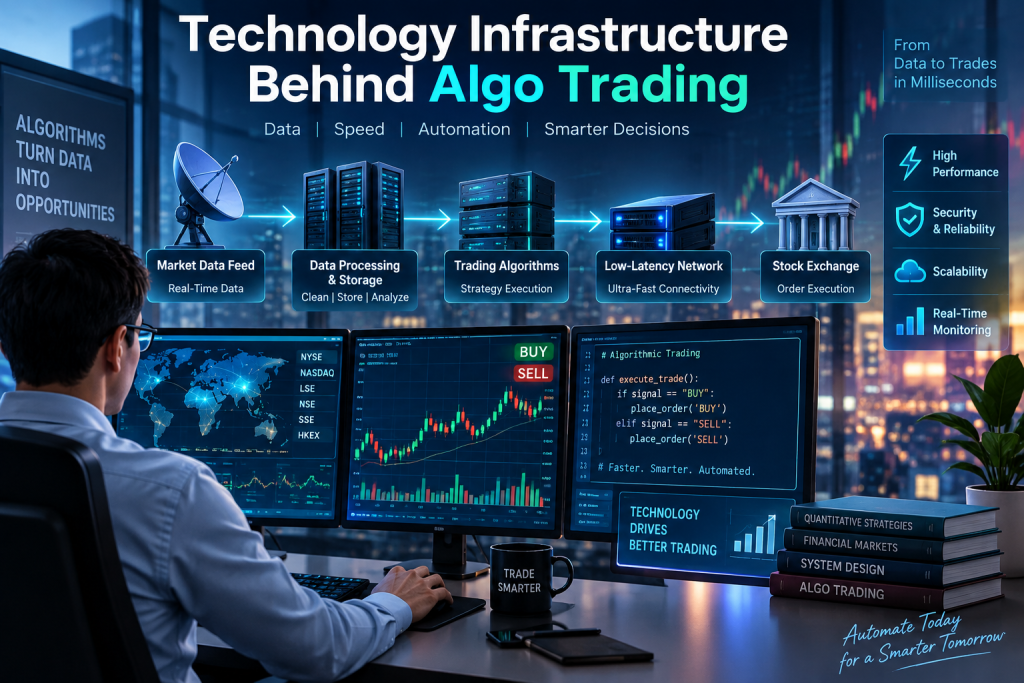
The technology supporting an algorithmic trading system can be just as important as the strategy itself. A typical system may include market-data feeds, analytical software, trading APIs, databases, execution engines, monitoring tools, and risk-management components.
Latency is particularly important for strategies that depend on very short-term price movements. Latency refers to the time required for information to travel through the system and for an order to reach the relevant trading venue. Strategies that trade over longer time horizons generally have less stringent latency requirements.
Cloud computing has also made sophisticated infrastructure more accessible. Instead of maintaining every component independently, developers can use cloud-based computing resources, databases, and monitoring services.
A basic architecture might include:
A robust infrastructure should also include safeguards against connectivity failures, unexpected data, software bugs, and unintended orders.
Benefits of Algo Trading for Modern Traders
Algo trading provides several potential advantages. One of the most obvious is speed. A computer can process predefined conditions and submit orders much faster than a person can manually analyze charts and enter a trade.
Another advantage is consistency. Human traders may change their decisions because of fear, greed, excitement, or fatigue. An algorithm can continue applying its programmed rules without experiencing these emotions.
Automation can also improve scalability. A single system can monitor multiple securities or markets simultaneously, something that can be difficult for an individual trader to accomplish manually.
Backtesting is another important advantage. Before deploying a strategy, developers can apply it to historical data to study how it might have behaved under previous market conditions.
Nevertheless, these benefits depend on implementation quality. Automation can amplify mistakes as efficiently as it executes good decisions.
Risks and Challenges of Algo Trading in 2026
Despite its advantages, algorithmic trading carries substantial risks. One major concern is technical failure. A software bug, incorrect parameter, disconnected API, or faulty data feed can produce unintended trades.
Another issue is market risk. Algorithms operate in environments where prices can move rapidly and unpredictably. A strategy that worked historically may stop working when market structure changes.
Overfitting is particularly relevant to quantitative systems. If a strategy is repeatedly optimized against historical data, it may appear highly profitable during testing without having genuine predictive value.
There are also transaction costs. Commissions, spreads, slippage, taxes, and other trading expenses can significantly reduce theoretical returns.
Furthermore, automated systems can create operational risks if safeguards are inadequate. Position limits, maximum-loss controls, order-size restrictions, and emergency shutdown mechanisms are therefore important components of responsible deployment.
Algo trading should be viewed as an automated execution and decision framework—not as a machine that guarantees profitable trades.
Algo Trading vs. Manual Trading
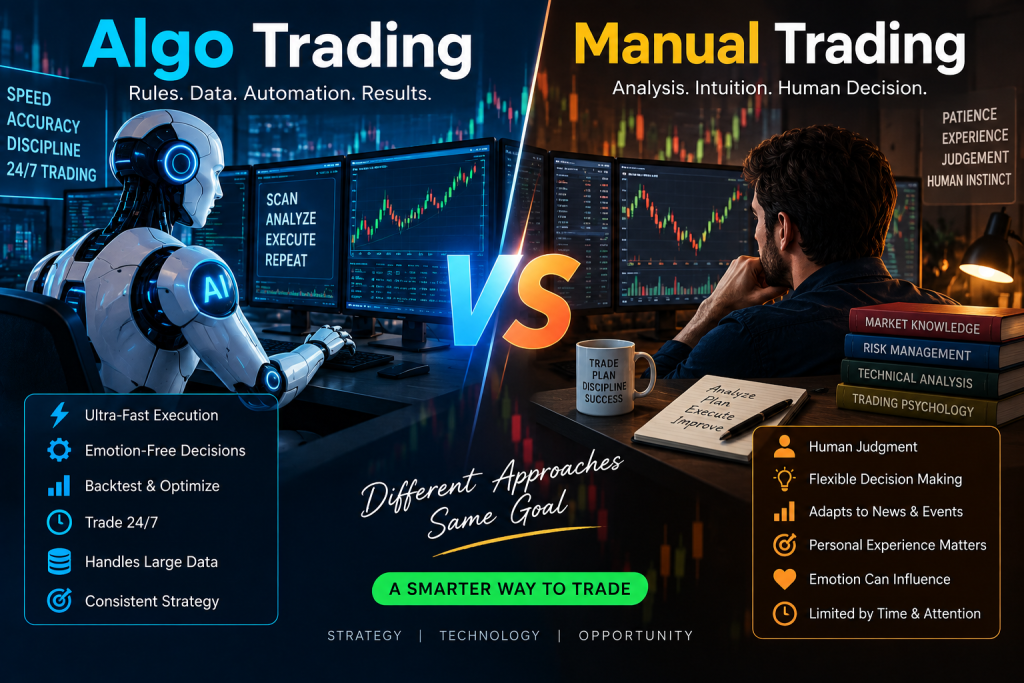
Manual trading and algorithmic trading represent two different approaches to market participation. In manual trading, the individual evaluates information and decides when and how to enter or exit a position. The trader remains directly involved throughout the process.
Algo trading transfers some or most of that decision-making process to software. Depending on the system, the trader may define the strategy while the computer handles analysis and execution.
Manual trading can be useful when qualitative judgment is important. A person may interpret unusual news, changing market sentiment, or contextual information in ways that are difficult to express through simple rules.
Algorithmic systems, meanwhile, are particularly useful when a strategy can be clearly quantified and repeated.
Neither approach is automatically superior. The appropriate method depends on the trader’s objectives, technical capabilities, strategy, risk tolerance, and market.
How Beginners Can Learn Algo Trading
Beginners should approach algorithmic trading as a combination of finance, mathematics, programming, and risk management. A strong foundation in basic market concepts is useful before attempting to build sophisticated systems.
The learning process can begin with understanding stocks, ETFs, market orders, limit orders, volatility, liquidity, returns, and risk. Programming knowledge can then be developed using languages commonly used for data analysis and trading research, particularly Python.
The next stage is learning how to obtain and clean historical data. Beginners should understand that poor-quality data can produce misleading backtest results.
Afterward, simple strategies can be developed and tested. A beginner might start with a basic moving-average system rather than immediately attempting to build an AI-powered trading model.
Paper trading or simulated environments can provide an additional testing layer before real capital is considered.
A sensible learning progression is:
Finance Basics → Programming → Data Analysis → Strategy Design → Backtesting → Paper Trading → Risk Management → Carefully Controlled Deployment
The objective should be to understand why a strategy works, where it can fail, and how its risks can be measured.
The Future of Algo Trading Beyond 2026
The future of algo trading is likely to involve increasingly sophisticated combinations of automation, artificial intelligence, alternative data, and real-time analytics. As computing resources become more accessible, advanced quantitative techniques may become available to a broader range of traders and institutions.
AI may increasingly assist with tasks such as market-regime classification, portfolio construction, risk assessment, and strategy research. At the same time, competition may make it harder to obtain persistent advantages from widely known strategies.
Regulation is another important part of the future. As automated systems become more influential in financial markets, regulators and exchanges are likely to continue focusing on market stability, transparency, operational controls, and responsible system design.
Human oversight is unlikely to disappear completely. Instead, the role of traders and portfolio managers may shift toward strategy development, model supervision, risk management, and interpretation.
Ultimately, the future of algorithmic trading will not simply be about creating faster software. It will be about developing more reliable, adaptive, transparent, and risk-aware systems.
Conclusion
Algo trading in 2026 is an automated approach to financial-market trading in which software uses predefined rules, quantitative models, or AI-assisted techniques to analyze data and execute orders. It can provide speed, consistency, scalability, and automation, but it also introduces technical, financial, and operational risks.
For beginners, the most important lesson is that successful algorithmic trading requires much more than writing a trading program. Strategy design, quality data, realistic backtesting, transaction costs, risk management, monitoring, and disciplined execution all matter.
As financial technology continues to evolve, algo trading will remain an important part of modern markets. Its greatest potential comes not from assuming that computers can predict every market movement, but from using technology to make well-tested
